What if the problem isn’t your mind… but the way it’s been conditioned?
Most people don’t realize this—but anxiety, stress, and even chronic pain aren’t just “in your head”… they’re patterns your mind has learned over time.
And here’s the powerful part: what’s learned can be unlearned.
In 2026, hypnotherapy isn’t some mystery anymore.
It’s backed by real science, real brain data, and real results.
We’re talking about measurable changes in how your brain processes fear, habits, and even physical discomfort.
That’s why more people are turning to #Hypnotherapy2026 as a way to break free from cycles that used to feel permanent.
Imagine:
- Finally quieting that constant overthinking
- Sleeping without your mind racing
- Letting go of habits that no longer serve you
This isn’t about losing control—it’s about taking it back.
With modern approaches like:
#AnxietyRelief | #PainManagement | #SubconsciousReprogramming
Change is no longer out of reach. It’s structured, guided, and deeply personal.
And the truth?
You don’t need years of struggle to create a shift.
You just need the right approach.
If you’ve been feeling stuck, overwhelmed, or ready for something to change… this might be your moment.
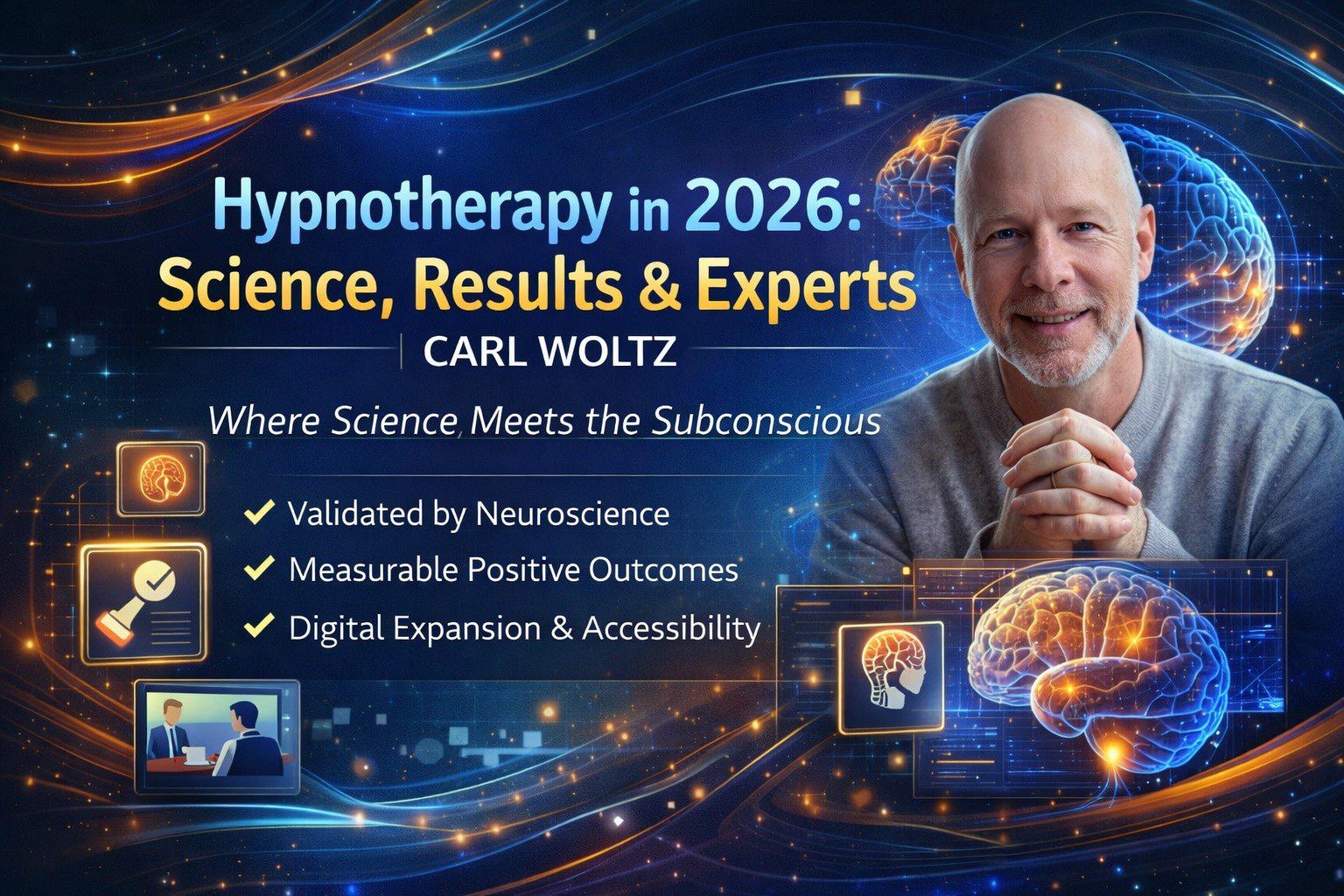
🧠 Hypnotherapy in 2026: Science, Results & Experts | Carl Woltz
What was once considered an alternative approach is now being reshaped…
By 2026, hypnotherapy is no longer seen as “stage tricks” or entertainment.
It has become a science-backed mental health tool used in hospitals, clinics, and psychotherapy practices worldwide.
Today, it is commonly used alongside modern psychology to help with:
- Anxiety and chronic stress
- Trauma recovery
- Chronic pain management
- Physical symptoms linked to the mind (somatic conditions)
👉 In simple terms: hypnotherapy is now understood as a way to retrain the brain’s response system using focused attention and guided suggestion.
🔬 Scientific Advancements (What Changed in 2026?)
🧠 1. Neuroimaging Evidence (Brain Scans)
Modern brain scans show that hypnosis is not imagination—it actually changes how the brain functions.
It affects three major areas:
- Anterior Cingulate Cortex (ACC)
- Default Mode Network (DMN)
- Pain Matrix
🧩 What these mean:
🔹 Anterior Cingulate Cortex (ACC)
This is the brain’s attention and emotion control center.
It helps you decide what to focus on and how strongly you feel emotions.
👉 Hypnotherapy helps “calm” overactive emotional reactions here.
🔹 Default Mode Network (DMN)
This is your brain’s inner voice system—the part active when you daydream, worry, or overthink.
👉 Hypnosis reduces mental noise like:
- rumination (“overthinking past events”)
- anxiety loops
- negative self-talk
🔹 Pain Matrix
This is the brain network that creates the experience of pain.
👉 Hypnosis can reduce pain perception by changing how the brain interprets signals.
🧪 2. Comparable to CBT (Cognitive Behavioral Therapy)
Studies called Randomized Controlled Trials (RCTs) show hypnotherapy can perform similarly or sometimes better than CBT for certain conditions.
🧠 What is CBT?
Cognitive Behavioral Therapy (CBT) is a structured talk therapy that helps people:
- change negative thoughts
- change behaviors
- improve emotional responses
👉 Think of CBT as “retraining your conscious thinking.”
👉 Hypnotherapy goes deeper—into subconscious patterns.
📊 3. Randomized Controlled Trials (RCTs)
These are scientific experiments where:
- one group receives hypnotherapy
- another group receives standard treatment
- results are compared fairly
👉 This is the “gold standard” of medical research.
📈 4. Reported High Success Rates
Some modern studies report high improvement rates (often cited around 90%+ in specific conditions), especially when:
- patients are highly suggestible
- sessions are structured
- therapists are trained clinically
⚠️ Important: Results vary by condition and individual—this is not a guaranteed cure.
🏥 Key Applications in 2026
💊 1. Chronic Pain Management
Hypnotherapy is increasingly used for:
- back pain
- migraines
- fibromyalgia
👉 It helps the brain “turn down” pain signals.
😰 2. Anxiety & Trauma
Used for:
- PTSD (trauma-related stress)
- panic attacks
- long-term anxiety
👉 It helps reprogram emotional responses stored in the subconscious.
🧍 3. Somatic Conditions
These are physical symptoms influenced by the mind, such as:
- IBS (Irritable Bowel Syndrome)
- stress-related digestion issues
- hot flashes
👉 Here, the brain and body are strongly connected.
👩⚕️ Expert Consensus in 2026
🧩 1. Integrated Therapy Approach
Doctors and psychologists now use hypnotherapy as:
👉 an add-on tool, not a replacement for therapy
It is often combined with:
- CBT
- talk therapy
- medication (if needed)
⚖️ 2. Ethical Practice
Experts strongly emphasize:
- only trained professionals should perform clinical hypnosis
- it is a medical/psychological tool, not entertainment
- it should focus on behavior change and subconscious reprogramming
In 2026, hypnotherapy is best understood as:
A scientifically studied method that uses focused attention and guided suggestion to help the brain change how it processes emotions, pain, and behavior patterns.
It is no longer “mystical”—it is:
- measurable
- clinically tested
- increasingly mainstream
Conclusion:
By 2026, hypnotherapy is widely recognized as an evidence-based therapeutic method used in modern healthcare. It is no longer seen as entertainment, but as a clinical tool integrated with psychology to help treat anxiety, trauma, chronic pain, and certain physical (somatic) conditions.
Research using brain imaging shows that hypnosis can influence key areas of the brain involved in attention, emotion, and pain perception. Studies also suggest it can be as effective as Cognitive Behavioral Therapy (CBT) for some conditions, often with faster results and fewer sessions.
Today, hypnotherapy is most commonly used alongside traditional therapy rather than replacing it, and it is only recommended when practiced by trained medical or psychological professionals.




 skills:
Connect Labours ranks top hospitals in Oregon based on patient feedback, care quality, and service excellenc
Duration of Work:
Not Applicable
availability:
Permanent
skills:
Connect Labours ranks top hospitals in Oregon based on patient feedback, care quality, and service excellenc
Duration of Work:
Not Applicable
availability:
Permanent