
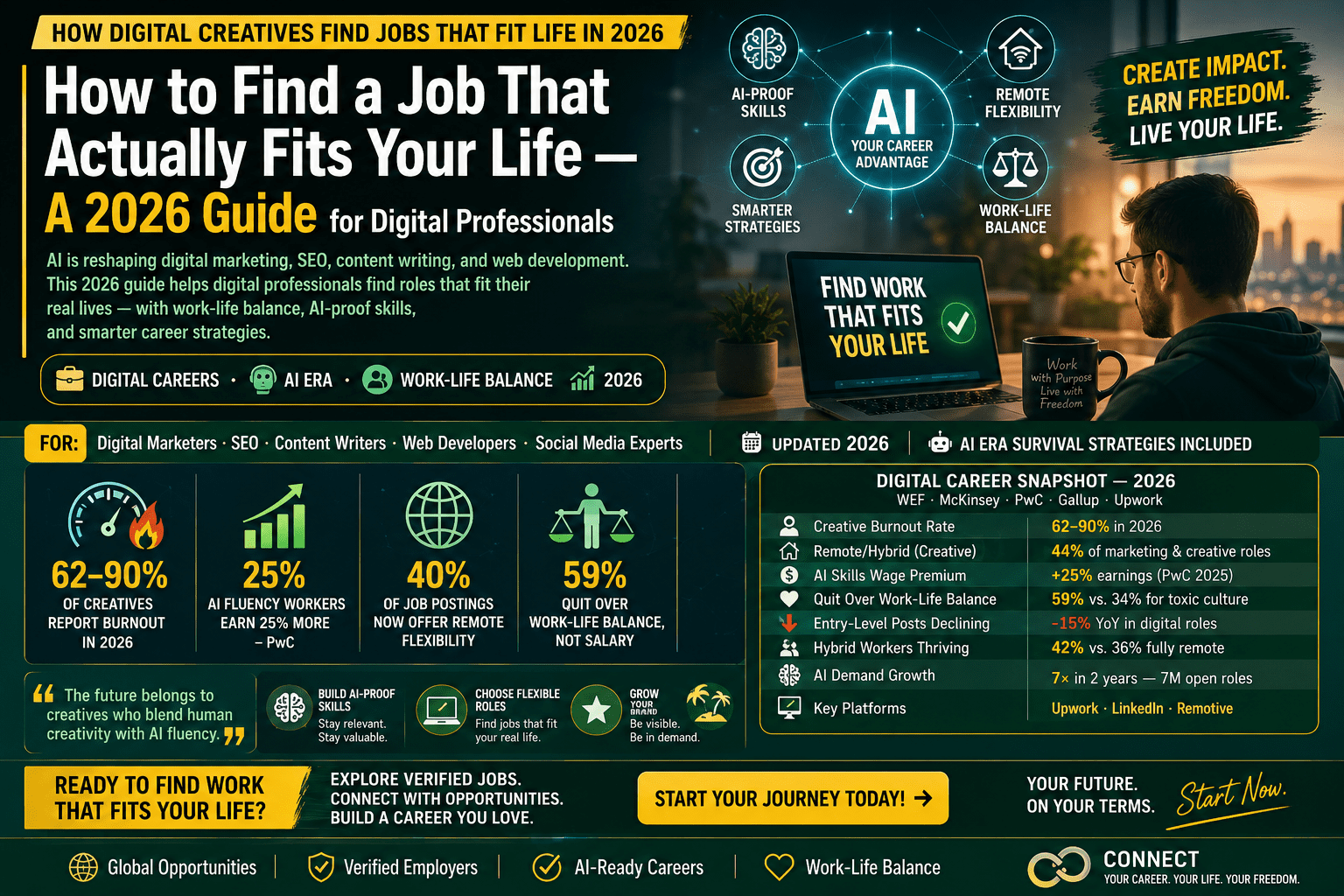
How to Find a Job That Actually Fits Your Life —
A 2026 Guide for Digital Professionals
WEF · McKinsey · PwC · Gallup · Upwork
| Creative Burnout Rate | 62–90% in 2026 |
| Remote/Hybrid (Creative) | 44% of marketing & creative roles |
| AI Skills Wage Premium | +25% earnings (PwC 2025) |
| Quit Over Work-Life Balance | 59% vs. 34% for toxic culture |
| Entry-Level Posts Declining | -15% YoY in digital roles |
| Hybrid Workers Thriving | 42% vs. 36% fully remote |
| AI Demand Growth | 7× in 2 years — 7M open roles |
| Key Platforms | Upwork · LinkedIn · Remotive |
- Overview — The Real State of Digital Careers in 2026
- What AI Is Doing to Digital Roles Right Now
- Role-by-Role Survival Guide
- The Burnout Crisis — Why It Matters More Than Salary
- How to Find a Role That Fits Your Life
- Building Real Work-Life Balance in a Digital Career
- Freelance vs. In-House vs. Agency — The 2026 Decision
- The 7 Skills That Will Keep You Employable
- Where to Find the Right Job in 2026
- External Links
- References
There is a particular kind of exhaustion that only digital professionals know — the kind that comes not from working too hard at one thing, but from working at everything, all the time, across every platform, for an algorithm that keeps changing the rules. You optimise a page and Google rewrites the SERP overnight. You build a social strategy and the platform pivots its reach model. You craft content and an AI tool produces a dozen variations in four minutes. In 2026, the question is not just "am I good at my job?" — it is "does my job still fit the human being doing it?" This guide is for every digital marketer, content writer, SEO specialist, web developer, and social media expert who has started asking that second question out loud.
1. Overview — The Real State of Digital Careers in 2026
The digital creative economy is in the middle of a structural rupture — and most job boards haven't caught up. According to Method Recruiting's 2026 Digital Marketing Hiring Trends report, many roles that existed five years ago — SEO Manager, Paid Media Specialist, Content Strategist — now require radically different skill sets. AI is not replacing these roles wholesale. It is hollowing out their execution layers while amplifying demand for the strategic, analytical, and creative intelligence that sits above them.
At the same time, the human cost of the digital career model is becoming impossible to ignore. Over 60% of marketing leaders believe their teams lack future-ready skills, according to Brill Creations' 2026 industry survey. Creative burnout affects between 62% and 90% of content creators. And 59% of workers have seriously contemplated leaving their jobs not because of pay, but because of work-life imbalance — now the single most potent driver of turnover in knowledge work.
The professionals who thrive in this environment will be those who make two parallel decisions: (1) skill forward into the AI era, and (2) redesign their working life around sustainable human rhythms. This guide covers both.
2. What AI Is Actually Doing to Digital Roles Right Now
The honest answer is: a lot more than most job descriptions admit, and somewhat less than the panic headlines claim. AI is not erasing digital roles in 2026. It is compressing them. One senior professional with AI tools can now produce the output that previously required a team of three or four junior practitioners. This is what is driving the 15% year-over-year decline in entry-level digital job postings — not mass redundancy, but structural efficiency gains at the execution tier.
What this means in practice, by function:
- 📝 Templated content writing — first-draft generation, product descriptions, social captions: largely AI-automated
- 🔍 Basic SEO audits — keyword extraction, meta tag generation, technical crawl analysis: AI-assisted to near-full automation
- 📊 Routine reporting and analytics — scheduled reports, performance summaries, A/B test recaps: fully automatable
- 🎨 Basic social graphics and post scheduling — canva-tier design and content calendars: AI handles this at scale
- 💻 Boilerplate code and component generation — standard UI components, WordPress templates, form logic: AI coding tools generate in seconds
What AI cannot yet replace in any of these roles: strategic direction, editorial judgment, brand voice interpretation, client relationship management, cultural nuance in messaging, and the kind of creative thinking that produces ideas nobody has had before. These are precisely the capabilities that hiring managers in 2026 are paying premiums to find.
3. Role-by-Role Survival Guide
3.1 SEO Specialists
SEO has arguably changed more radically than any other digital discipline in the past 18 months. The rise of Google AI Overviews, ChatGPT search, and Generative Engine Optimization (GEO) means that ranking is no longer just about blue links — it is about being cited by AI synthesis engines that answer queries directly. National University's 2026 marketing skills report states that employers are now looking for marketers who can optimise for AI search optimisation (AIO) — structuring content to appear in AI Overviews through E-E-A-T, factual clarity, and semantic authority.
What SEO professionals must prioritise in 2026:
- 🧠 GEO & AEO mastery — learn to structure content for AI citation, not just blue-link ranking. This is the fastest-growing new discipline in search.
- 📊 Technical SEO + AI workflow integration — using AI tools to scale audits, then applying human judgment to prioritise and interpret them
- 💡 Content strategy over content production — move from writing to directing; from execution to architecture
- 🔗 CRO (Conversion Rate Optimisation) crossover — SEO roles in 2026 demand awareness of what happens after the click
- 📈 Data literacy — GA4, Search Console, and AI-generated insight interpretation are now baseline expectations, not differentiators
3.2 Content Writers
Content writers face the most acute execution-level pressure of any digital role. AI tools can produce first drafts, product descriptions, social captions, and email sequences faster than any human typist. The writers who are thriving in 2026 are not competing with AI on speed. They are doing something fundamentally different from what AI does — they are bringing perspective, original research, cultural intelligence, and genuine voice to work that a language model cannot authentically produce.
- First-draft content generation from a brief
- Product description writing at scale
- Social media caption variation
- Meta title and description generation
- FAQ section creation from existing content
- Email sequence templating
- Original reporting, research, and source journalism
- Brand voice development and consistency enforcement
- Long-form thought leadership and editorial direction
- GEO/AEO-optimised content architecture for AI citation
- Content strategy — deciding what to create, not just creating
- Audience psychology and narrative persuasion
The most future-proof content writers in 2026 are positioning themselves as content strategists who happen to write — not writers who happen to know a bit of strategy. The role has elevated, not disappeared.
3.3 Social Media Experts
Social media management has bifurcated sharply. The scheduling, captioning, basic graphic production, and hashtag optimisation tier is now largely AI-handled. What remains — and what employers increasingly pay well for — is the community intelligence, cultural timing, and brand trust management that requires a human with genuine platform instinct. According to National University's 2026 report, social media success is now defined not by posting frequency but by "managing social channels as an active business function that supports brand trust, demand generation, and customer retention."
Key pivots for social media professionals:
- 📱 Short-form video strategy — ideation, scripting, and performance analysis of video content (reels, TikTok, YouTube Shorts) remains human-led
- 🤝 Creator economy partnerships — identifying, briefing, and managing influencer and creator relationships requires relational intelligence
- 📊 Social listening and community analysis — interpreting what communities actually mean beyond what they literally say
- 🔥 Crisis management — real-time brand reputation management under pressure is irreducibly human
- 🧭 Platform-specific algorithm fluency — understanding how organic and paid reach interact on each platform at a strategic level
3.4 Web Developers
Web development is experiencing a profound split between AI-assisted commodity work and high-value specialist engineering. Boilerplate UI components, standard WordPress configurations, basic landing pages, and CSS styling are increasingly handled by AI coding tools (GitHub Copilot, Cursor, Bolt.new) with minimal human input. The US Bureau of Labor Statistics projects a 17.9% employment increase for software developers from 2023 to 2033 — but that growth will not be uniformly distributed.
Web developers who will thrive are those moving into:
- ⚡ Performance and Core Web Vitals engineering — technical depth that AI tools cannot reliably optimise
- 🔒 Security architecture and penetration awareness — increasingly valuable as AI creates new attack surfaces
- 🤖 AI integration development — building AI-powered features, chatbots, and automation workflows into web products
- ♿ Accessibility engineering — WCAG compliance and inclusive design require deep human judgment
- 🎨 Design systems and design-to-code workflows — the human judgment layer between Figma and production
- 📐 Full-stack product thinking — developers who understand the business and user problem, not just the technical implementation
3.5 Digital Marketers & Performance Marketers
The most significant shift in digital marketing roles in 2026 is the move from execution accountability to revenue accountability. Method Recruiting's 2026 Hiring Trends report states that companies are now hiring fewer generalists and more specialists who can directly influence measurable growth. The role of Performance Marketing Manager has evolved to require ownership of paid search, paid social, and conversion rate optimisation simultaneously — with AI tools handling the mechanics of bidding and reporting while humans handle strategy, interpretation, and client relationships.
The highest-demand digital marketing roles in 2026:
- AI Marketing Manager — designs and optimises AI-powered systems for personalisation, automation, and predictive analytics
- SEO & GEO Growth Strategist — covers technical SEO, content architecture, and AI search optimisation
- Performance Marketing Manager — paid search, paid social, and CRO ownership with a revenue lens
- Marketing Data Analyst — translates AI-generated insights into human decisions
- Content Strategist (AI-Augmented) — editorial direction, brand voice governance, and distribution strategy
4. The Burnout Crisis — Why It Matters More Than Your Next Salary Negotiation
Here is a statistic that should stop every hiring manager and digital professional in their tracks: 59% of employees have actively contemplated quitting their current role due to burnout from poor work-life balance — more than the 34% who would leave over a toxic work environment. Work-life imbalance is now the single most potent driver of turnover in knowledge work, according to 2026 workplace research.
For creative and digital professionals specifically, the numbers are even more alarming. Recent data shows that 62–90% of content creators experience burnout in 2026, driven by algorithm pressure, relentless creative fatigue, financial instability, and AI-induced professional anxiety. Among fully remote workers — the category that includes most digital freelancers — burnout rates reach 86%.
The three root causes most consistently identified by research are: financial instability (number one driver among freelancers), blurred work-life boundaries (40% of remote workers cannot disconnect after hours), and AI-amplified workload expectations — the assumption that because AI can make you faster, you now owe your employer twice the output. Recognising these causes in your current or prospective role is the most important career self-preservation skill of 2026.
5. How to Find a Role That Actually Fits Your Life
The phrase "work-life balance" has become so overused it has nearly lost meaning. What it actually means, in practical terms, is this: a role in which the demands of the work are proportionate to what a human being can sustainably give, with enough space remaining for health, relationships, rest, and growth outside of work. For digital professionals navigating AI disruption in 2026, finding that kind of role requires a deliberate framework — not just scrolling job boards and hoping.
- Which tasks in your current role can AI already do? Be precise, not vague.
- What percentage of your working day is execution-level (AI-replaceable) vs. strategic/relational?
- Are you currently being paid for your execution or your judgment? The former is under threat; the latter is appreciating.
- Is your burnout driven by overwork, under-appreciation, financial pressure, or AI anxiety? The cure differs for each.
- What are your non-negotiables? (Location, hours, income floor, team culture, career growth path)
- Do you want to deepen one specialism (SEO, copy, dev) or broaden across the AI marketing stack?
- Is remote, hybrid, or in-office right for your working style? (Hybrid workers report the highest thriving rate at 42%)
- What kind of organisation model suits your life — agency, in-house, freelance, or productised services?
- Ask directly: "What does a typical week look like in this role — and what does a heavy week look like?"
- Ask about AI tool policy: are staff encouraged to use AI to reduce workload, or to increase output targets?
- Ask about after-hours communication culture. 81% of remote workers check email outside hours — is this expectation or choice in this role?
- Ask about promotion paths — are they moving from execution to strategy, or adding to execution?
- Use AI tools to research companies' review scores (Glassdoor), culture signals, and turnover history before applying
- Ask AI to analyse a job description for red flags: scope creep, impossible responsibilities, misaligned seniority vs. pay
- Use AI to tailor your CV to ATS systems for each application — without fabricating skills you don't have
- Build a public portfolio with AI-assisted work clearly labelled — authenticity is now a trust signal in itself
6. Building Real Work-Life Balance in a Digital Career
The research data on what actually works for remote and creative professionals is surprisingly specific. This is not about vague wellbeing advice — it is about evidence-based practices that the data shows reduce burnout and increase sustained performance.
- 🕐 Define and defend a hard stop time. Research shows that 40% of remote workers cannot disconnect after scheduled hours. The single most effective intervention is a physical end-of-day ritual that closes work: shutting a laptop, changing clothes, leaving the room. Without a physical transition, the workday never ends.
- 💤 Protect recovery time the way you protect client deadlines. Studies show that regular breaks increase productivity by ~20% and creativity by ~15%. You are not more valuable when you work more hours — you are less reliable.
- 🤳 Digital communication boundaries are not optional. 69% of remote workers say digital communication tools have worsened their burnout. Turn notifications off after hours — not silent, off. The urgency most digital notifications create is manufactured, not real.
- 🤝 Prioritise hybrid over fully remote if your personality allows it. Hybrid workers report the highest thriving rate (42%) and the best work-life balance outcomes in 2026, compared to both fully remote and fully in-office setups. The social dimension of work is a genuine wellbeing input, not a corporate attendance policy.
- 🧘 AI as workload relief, not workload amplifier. The most psychologically healthy use of AI tools in a digital role is using them to produce the same output in fewer hours — then using those hours for rest, learning, or life. The worst use is producing more output in the same hours until you break.
7. Freelance vs. In-House vs. Agency — The 2026 Decision
- ✅ Salary stability, benefits, team culture
- ✅ Deep knowledge of one brand/product
- ✅ AI tools provided — workload relief potential
- ⚠️ Risk: role scope creep as AI reduces headcount
- ⚠️ Risk: over-specialisation without market breadth
- 💡 Look for companies with genuine AI-upskilling investment and internal mobility
- ✅ Exposure across multiple industries and clients
- ✅ Fast skills development — you learn more, faster
- ✅ Team energy and creative peer pressure
- ⚠️ Risk: highest burnout rates of any digital work model
- ⚠️ Risk: often under-resourced as AI reduces perceived need for juniors
- 💡 Ideal as a 2–3 year development phase, not a long-term home for most
- ✅ Full schedule control — the ultimate work-life fit tool
- ✅ AI tools make solo practitioners more competitive than ever
- ✅ Global client access — location no longer limits earnings
- ⚠️ Risk: financial instability (number one burnout driver for freelancers)
- ⚠️ Risk: loneliness and isolation (22% of remote workers report this)
- 💡 Best with 3+ months' income saved before going full-time freelance
8. The 7 Skills That Will Keep Digital Professionals Employable
Based on research from Upwork Research Institute, WEF Future of Jobs 2025, and PwC's AI Jobs Barometer, these are the seven skills that consistently appear at the top of employer demand lists for digital professionals in 2026:
9. Where to Find the Right Job in 2026
Key principles for a smarter 2026 job search:
- Filter by flexibility upfront — Remotive.com and We Work Remotely specialise in remote digital and tech roles. 40% of job postings worldwide now include some remote flexibility — stop applying to the ones that don't if location matters to you.
- Use Glassdoor's culture data before any application — Glassdoor reviews on work-life balance, management quality, and whether "reasonable hours" is a selling point or a lie are among the most reliable pre-application signals available.
- Look for companies investing in AI upskilling — 77% of WEF employers plan to upskill rather than simply replace staff. Companies that have published internal AI learning programmes are signalling genuine investment in their human workforce.
- For freelancers — position around outcomes, not hours — Upwork's 2025 hiring data shows that small and medium businesses are actively seeking creative professionals with specialised outcome-based expertise, not hourly commodity work. Your profile should answer "what result do I produce?" not "what tasks do I perform?"
- Build a network that leads to work — Working Not Working (for creatives) and Growth Collective (for marketers) are community-driven platforms where opportunity travels through professional relationships faster than any algorithm.
AI is reshaping every digital role — but it is hollowing out execution layers, not eliminating professions. The digital professionals who will thrive in 2026 are those who move from executing tasks to directing systems: from writing content to architecting content strategy, from building pages to engineering AI-integrated experiences, from running campaigns to designing AI-powered marketing machines. The skills that protect and reward in 2026 are AI fluency (+25% earnings), data literacy, GEO/AEO content architecture, strategic communication, and visible expertise. Simultaneously, the burnout data is too severe to ignore: 62–90% of creative professionals are experiencing burnout, and 59% are considering quitting over work-life balance, not salary. Finding a job that fits your life in 2026 requires redesigning both your skills and your boundaries — making AI work for your wellbeing rather than against it, and choosing roles that value your human judgment, not just your human hours.
External Links & Resources
- 📊 Method Recruiting — Digital Marketing Hiring Trends 2026
- 🎓 National University — Top Marketing Skills Employers Value in 2026
- 🌐 Brill Creations — Digital Marketing Skills Every Professional Needs in 2026
- 🤖 Murray Resources — Top 25 AI Marketing Jobs 2026
- 📈 Upwork Research Institute — High-Demand Careers 2026
- 🔥 Automateed — Burnout Recovery Plan for Creatives 2026
- 📉 SpeakWise — Work-Life Balance Statistics 2026
- 🏠 Chanty — Remote Work Statistics 2026
- 🌍 Remotive — Remote Digital & Marketing Job Board
- 💼 We Work Remotely — Remote SEO, Dev & Marketing Jobs
- 🎨 Working Not Working — Creative Professional Community & Jobs
- 📊 Growth Collective — Vetted Digital Marketing Freelancers
- ⭐ Glassdoor — Company Culture & Work-Life Balance Reviews
- 🌐 Wikipedia — Digital Marketing
- 🌐 Wikipedia — Work-Life Balance
- 📄 WEF Future of Jobs Report 2025 — Full PDF
References
- Method Recruiting — Digital Marketing Hiring Trends for 2026 (April 2026)
- National University — Top Marketing Skills Employers Value in 2026 (March 2026)
- Octopus Marketing Agency — Future Digital Marketing Skills 2026 (March 2026)
- Upwork Research Institute — High-Demand Careers in 2026 (February 2026)
- Murray Resources — Top 25 AI Marketing Jobs 2026 (February 2026)
- SpeakWise — Work-Life Balance Statistics 2026 (February 2026)
- Chanty — Remote Work Statistics 2026 (March 2026)
- Automateed — Burnout Recovery Plan for Creatives 2026 (February 2026)
- A Magical Mess — Why Creative Burnout Is Rising (April 2026)
- WorkTime — Remote Work Statistics 2026 (May 2026)
- World Economic Forum — Future of Jobs Report 2025
- PwC — Global AI Jobs Barometer 2025
This guide reflects career data, hiring trends, and research current as of May 2026. Job market conditions evolve rapidly — always verify current role requirements at LinkedIn Jobs, Remotive, and Glassdoor.
Published May 15, 2026 · CONNECT Career Desk · Pacific Northwest, USA